Julian Hollis — author of a new evidence-built series on attachment and relationships
Out now · The first book in The Relationship Series
Attachment and relationship books for the patterns keeping you stuck, or the person you love
Understand situationships, mixed signals, relationship anxiety, avoidant partners and how to build a secure relationship — whether you're living the pattern or loving the person who is. Research, practical frameworks, and the exact words to use next.
I'm stuck in…
How these books work
A whole book on the pattern you're living.
Inside the pattern
Every chapter is about your style — written to be read from the inside. Not a verdict, but a map of what's happening, and why.
Depth that holds
A five-part journey, a Decoder at the end of every chapter, and the real questions readers ask — answered in plain language, all the way through.
Tools for the moment
What to actually do during activation, conflict, silence and withdrawal — situation by situation, not theory.
The relationship you're in
Written for two readers at once — the one living the pattern and the one who loves them — and honest about boundaries, including when to walk away.
Start here.
One book is out now — the complete guide to undefined relationships. New titles will follow; join the list below to hear about each one first.
Explore the situationship bookThe evidence promise
Every claim in these books is labelled by its evidence strength — peer-reviewed, strongly inferred, or original framework — so you always know what you're standing on.
The dual-audience promise
Each book is written for two readers at once: the person living the pattern, and the person trying to love them through it.
The coverage promise
610 real questions answered across the catalogue — the questions people actually type into search bars at 2am, printed in each book and answered in the text.
Out now · Also by Julian Hollis
The Relationship Series
The same method, turned on the questions that come before the pattern is named — dating, situationships, and how to read what's in front of you. The first title is out now, with the full collection to follow.
Read the first chapter · From the published edition
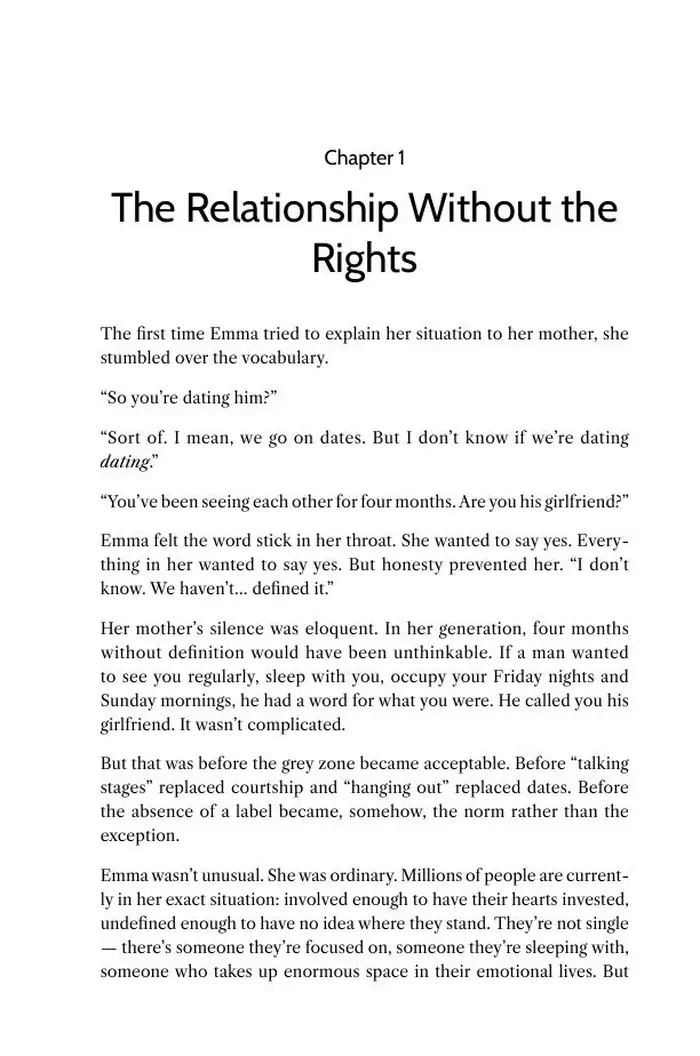
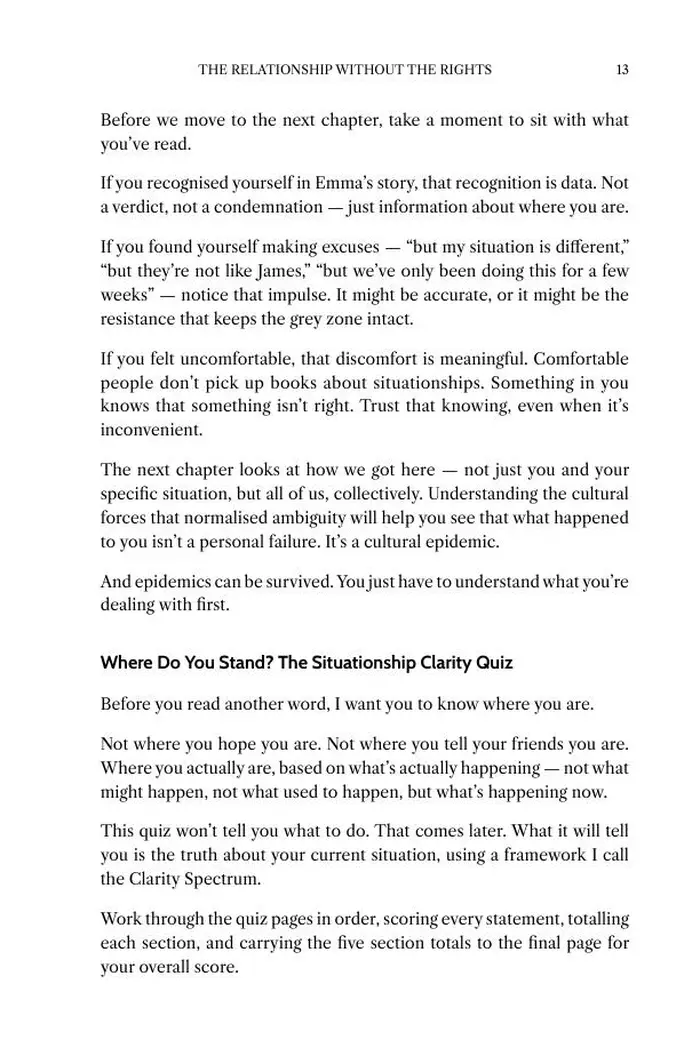
Chapter 1 — The Relationship Without the Rights
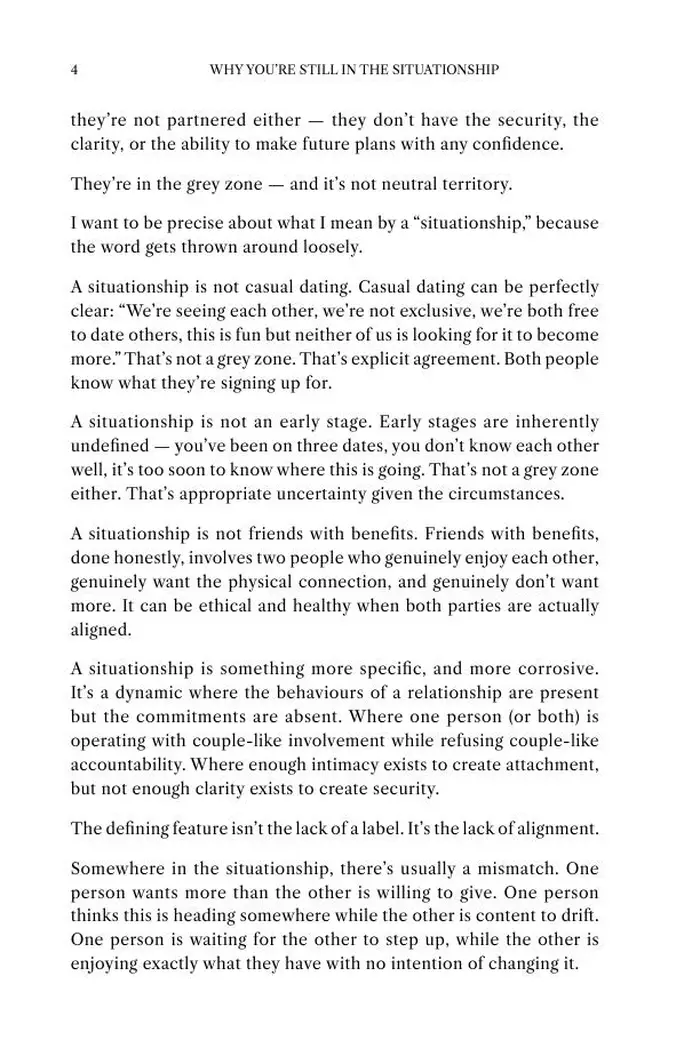
The opening chapter of Why You're Still in the Situationship, exactly as it appears in the book.
That's the opening chapter.
The five profiles, the instruments, the Script Library and the way out are all in the book.
Buy on Amazon Get new-title updates
The Relationship Series · Out now
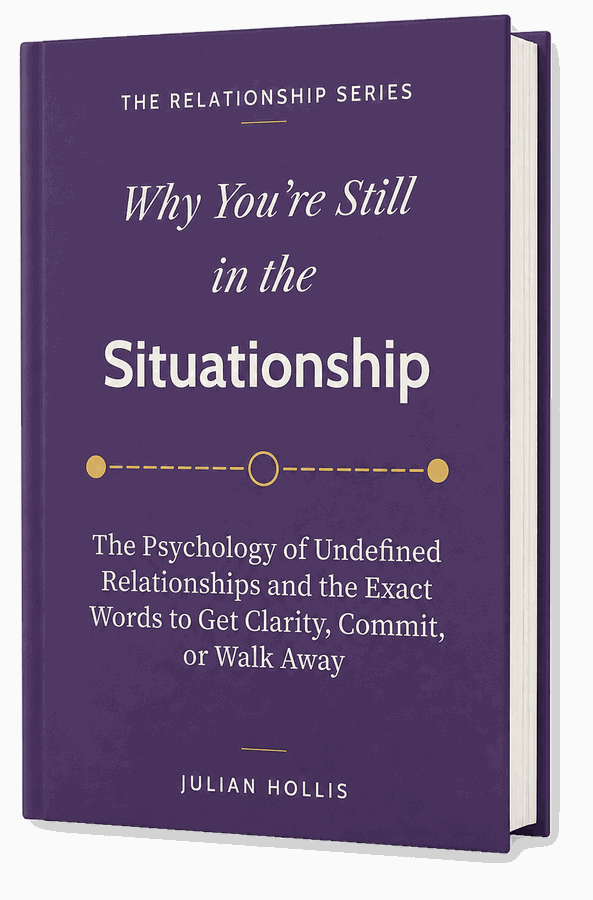
Why You're Still in the Situationship
The Psychology of Undefined Relationships and the Exact Words to Get Clarity, Commit, or Walk Away
You act like a couple. You just can't say the word. And you've stopped asking why. A situationship isn't nothing — that's exactly what makes it so hard to leave.
This book is for you if…
- You behave like a couple, but they avoid calling it a relationship.
- Their mixed signals leave you constantly overthinking.
- They become attentive when you pull away — and distant when you ask for clarity.
- You are unsure whether to stay, wait, or leave.
- You want the exact words for the "What are we?" conversation.
- You have tried to end it before, and kept being drawn back in.
A situationship isn't casual dating — casual can be perfectly clear. It's something else: mixed signals that feel like momentum, a partner who won't commit but won't let go, enough warmth to keep you close, and no name for any of it. If you've been living in that gap — rehearsing a question you never quite ask — this book was written for you.
The field guide
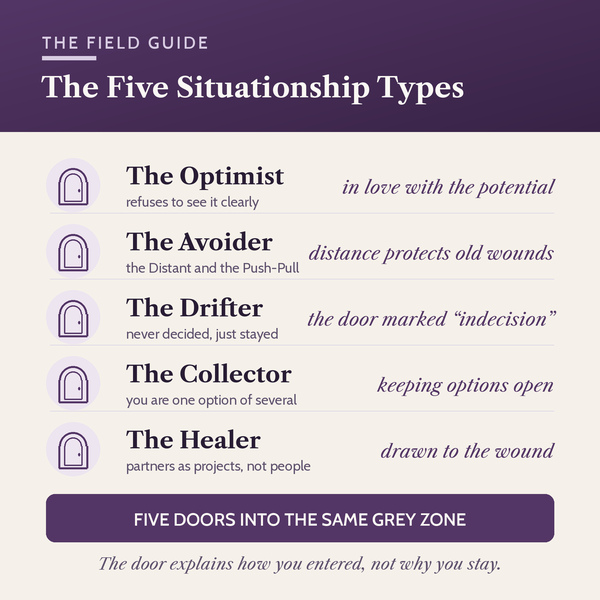
What a situationship actually is, the five profiles who keep things undefined — the Optimist, the Avoider, the Drifter, the Collector, the Healer — and a decoder for breadcrumbing, benching, the slow fade and the hoover.
The science
Why the wrong person can feel like unmistakable chemistry, what sustained uncertainty does to your nervous system, and why grief without an ending hurts the way it does — peer-reviewed, cited chapter by chapter.
The instruments
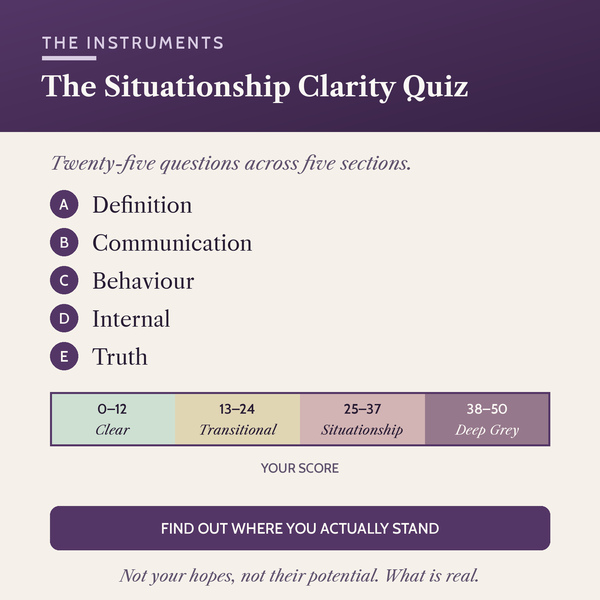
A twenty-five-question clarity quiz, a relationship readiness assessment and a consistency test — full-page graphical instruments you work through on the page, not paragraphs of questions.
The toolkit
The Clarity Principle. The Wanting Inventory. The Thirty-Day Verification Period. The Clean Exit. Named graphical frameworks for every stage of getting unstuck.
The Script Library
Ten complete sections of word-for-word scripts — the check-in, the where-is-this-going conversation, the exit, the no-contact boundary — each with responses for whatever they say back.
The way forward
What secure love actually feels like, how to date with clarity from the first week, and how the apps and algorithms shape all of it.


Every chapter closes with its research notes. The book runs on three lanes, declared in the open: peer-reviewed findings, converging clinical evidence, and the author's own frameworks — never dressed up as more than they are. Ninety-plus works cited in full.
The questions people actually type at 2am — each one answered in this book. Tap any of them.
“Am I actually in a situationship?”
If you have to ask, the ambiguity is already telling you something. The honest test isn’t how it feels on the good days — it’s whether what you have survives a direct question about what it is. The full answer — including the twenty-five-question Situationship Clarity Quiz, scored and interpreted on the page — opens the book.
“Are we exclusive if we never said it?”
Assumed exclusivity is the most common misreading in undefined relationships: one of you is honouring an agreement the other never made. Exclusivity that hasn’t been said out loud isn’t an agreement — it’s a hope. Chapter 1, The Relationship Without the Rights, maps what you actually have against what you’re assuming.
“Why do they act like a partner but refuse the label?”
Because the current arrangement gives them the warmth of a relationship without its obligations — sometimes by strategy, sometimes by drift. The book calls it motivated ambiguity: the label is often withheld because the ambiguity is working for someone. Chapter 3 names the uncomfortable reasons — and which of them can change.
“How long is ‘too long’ in the talking stage?”
Longer than you think, and shorter than you fear — because the real measure isn’t weeks, it’s direction: whether definition is approaching, or being managed away. When patience has quietly become denial, that’s the line. Chapter 13, When to Force the Question, gives you the timing framework.
“How do I ask ‘what are we?’ without sounding needy?”
Wanting to know where you stand isn’t neediness — it’s the minimum information any adult is entitled to. What matters is asking from steadiness rather than panic, and knowing in advance what you’ll do with each possible answer. Chapter 14, The Clarity Conversation, scripts the whole exchange — including the answers you’re afraid of.
“Can a situationship turn into a real relationship?”
Sometimes — and the honest version of that answer has conditions attached, which is why most advice avoids giving it. It depends on why it’s undefined, and whether definition is being avoided or simply hasn’t been reached yet. Chapter 9, Who Situationships Actually Work For, sets out the specific conditions under which it happens.
“What do I do when they come back weeks later saying they’ve changed?”
First, understand what the return usually is: not evidence of change, but evidence that your absence registered. Change shows up as sustained different behaviour — never as a feeling announced in a message. Script 9, the Hoover Response, gives you the exact words, and the Thirty-Day Verification Period shows you how to test the claim.
“How should I respond to their random late-night ‘hey stranger’ texts?”
A breadcrumb is low-effort contact designed to keep you available, not to bring you closer — and the kindest thing you can do for yourself is stop rewarding it. The reply that protects you is calm, brief, and doesn’t reopen the door. Script 10, the Breadcrumb Response, is written out word for word.
“Why do I miss them even when they treated me poorly?”
Because you’re grieving something real: intermittent warmth bonds harder than steady warmth, and an ending nobody announced gives your mind nothing to close around. That’s ambiguous loss — and it’s why this can hurt more than a ‘real’ breakup. Chapter 5 treats it as the genuine grief it is.
“How do I avoid ending up here again?”
By changing what you verify, not what you hope: clarity from the first week, consistency measured over time, and a standard you hold before attachment forms rather than after. Chapter 19, Dating With Clarity, builds the whole approach — so you never need this book twice.
“Do they actually care about me?”
In an undefined relationship this is the question underneath every other question — and the answer lives in behaviour, not words. Someone can care and still never commit; someone can say all the right things and be keeping you as an option. Chapters 6 and 8 give you the decoder: the five situationship types, and what each one’s behaviour actually means.
“How do I detach from someone who won’t commit?”
Not by waiting for the feeling to fade — by understanding that you’re withdrawing from an intermittent-reward bond, a physiological process far more than a test of character. Knowing what the withdrawal will do, and roughly when, is most of surviving it. Chapter 17, Staying Gone, walks the process day by day.
“Is it my fault it never became a relationship?”
Self-blame after an undefined relationship is a symptom of the ambiguity, not insight into you: with no external explanation to point at, the mind manufactures an internal one. The honest accounting is gentler — and more precise — than the story running at 2am. Chapters 5 and 10 take it apart properly.
These are thirteen of the twenty-five questions this book answers. The full map — If You Came Here Asking — is printed inside, question by question, each answered in full.
Start anywhere. In one now? Chapter 1 and the quiz. Just out? Chapters 16–17 were written for exactly this week. Keep ending up here? Chapters 7–8 and 19 are about the pattern, not the person.
Julian Hollis writes about relationships and modern dating culture — books built to name what you're living precisely, and honest about their evidence. This is the first title in a growing catalogue: the next books are already written, and the next arrives in August 2026. Be first to hear →
Buy in the UK · US · Canada — or read the first chapter free.
Clarity is not pressure.
You're allowed to know where you stand. By the last page you'll know what you want — and exactly what to say.
Buy on AmazonJulian Hollis
Julian Hollis writes on attachment and relationship patterns, pairing peer-reviewed research with composite real-world vignettes drawn from years of observing these patterns.
The work grew out of a simple frustration: understanding the inner world of insecure attachment is one thing, and getting real tools to change it is another — and you rarely get both in one place. So these books do both — the pattern explained from the inside, and a realistic path through it.
Every book is written for two readers at once — the person living the pattern and the person trying to love them through it. The chapters answer both readers' questions side by side, the Decoders at every chapter end translate behaviour for the partner without shaming the person behaving, and the Letters Interludes let each style speak for itself, in its own voice, without interruption.
The method
Every claim is labelled by its evidence strength — peer-reviewed, strongly inferred, or original framework — so you always know what you're standing on. Where the research is direct, it's cited; where it's converging inference, it's flagged; where a framework is original, it says so, openly, and invites you to test it against your own experience. Across the catalogue that means hundreds of peer-reviewed sources, each book's claims traceable, and not one composited story passed off as a case file.
The books
The catalogue opens with the Relationship Series — a growing collection — with the Attachment Series to follow.
- Why You're Still in the Situationship — out now. For the relationship that has no name and no direction: the psychology of why you're stuck, and the exact words to get clarity.
- The Attachment Series — a new title arrives in August 2026, with the full series to follow; join the list to be first to hear.
Questions & answers
Attachment, dating, and relationships — explained. And which book you need.
Start with what's out now.
Why You're Still in the Situationship is live — and new titles are in production.
Explore the situationship book