Julian Hollis

The Journal

Short, clear answers to the questions people actually ask about attachment, relationships and modern love — researched like the books, written for real life.

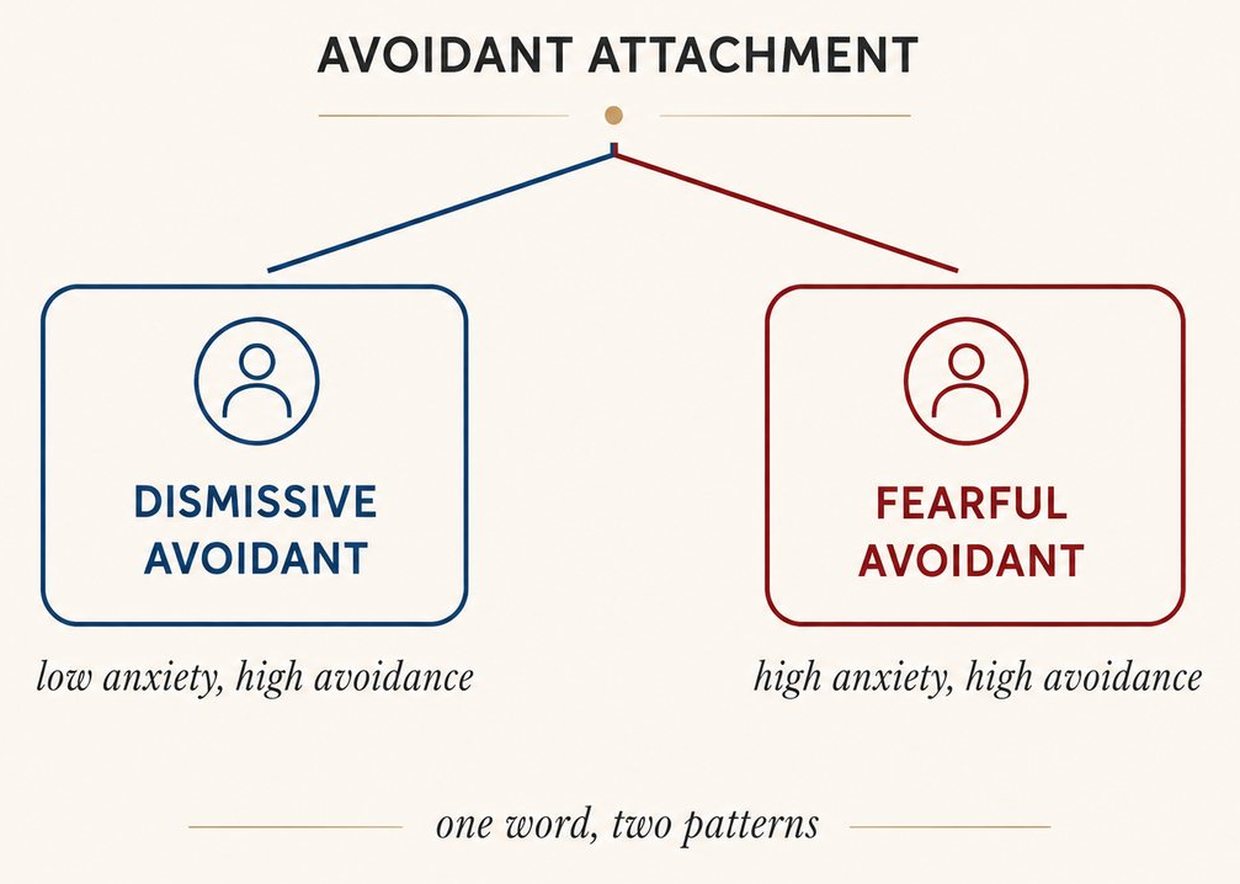
Avoidant attachment splits into two patterns: dismissive avoidant and fearful avoidant, which differ across attachment anxiety and avoidance

Start here · Attachment

Avoidant attachment: which avoidant pattern do you mean?

“Avoidant” points to two different patterns — dismissive and fearful. See how they differ, and which guide fits.

Read the guide →
Commitment is a behaviour, not a feeling: four behaviours in a row, consistency (the same person on a hard week), specificity (plans with dates, futures with shapes), repair (coming back with words), naming (saying out loud what this is). Beneath, two boxes: commitment issues, dashed, wants it and cannot yet do the four, reaches for you, can change slowly, the pattern that can move; the wrong person, solid, can do the four and is not choosing to, does not reach, your patience will not change it, the fact you act on. Four behaviours, one question.

Relationships · 6 min read

How to commit to a relationship, and how to tell whether they can

Commitment is a behaviour rather than a feeling. What it looks like, why it stalls in an ambiguous relationship, and how to ask for it without an ultimatum.

Read the article →
A fortress drawn as a solid outer wall, labelled from outside: capable, independent, hard to reach; inside it a dashed room labelled from inside: needing someone ends badly, so need as little as possible, the caring goes into doing, the door is here. A small open door beneath, and the line: what moves it, evidence that closeness did not end in harm. The fortress, from inside.

Attachment · 6 min read

Dismissive avoidant attachment in men: what it looks like from the inside

Capable, independent, hard to reach. Why the pattern is so often mistaken for not caring, and what it is actually protecting.

Read the article →
One sentence in a box,

Relationships · 6 min read

"What are we?" How to ask where you stand without a fight

When to ask, the words that keep it calm, and what each of the four answers is telling you.

Read the article →
A wavy line labelled the surface: warm, distant, warm, with four boxes hanging beneath it: pattern one, the undefined relationship, warmth is easy and commitment never asked; pattern two, the avoidant retreat, the quiet follows the best moments; pattern three, the push-pull, wanting it and fearing it together; pattern four, honest ambivalence, the feelings are mixed too. Stop reading and ask; one move works for all four. Same signals, four patterns.

Relationships · 6 min read

Mixed signals, decoded: the dating patterns behind hot and cold

Warm, then distant, then warm again. Four patterns produce the same signals for different reasons — and one move works for all of them.

Read the article →
A balance beam tipping slightly to the right. Left pan, what it gives: good days, company, affection, hope. Right pan, what it costs: the work without the standing, a question dodged, a life getting smaller. Beneath: if nothing about this changes, do I want it in six months? A decision asks you to choose; an ultimatum asks them. The question is not how long.

Relationships · 6 min read

When to walk away from a situationship

Not a rule about months. Four signs the arrangement is costing you, and a way to decide that keeps your footing.

Read the article →
Four attachment patterns on one map.

Start here · 6 min read

The four attachment styles, explained in plain words

Anxious, dismissive-avoidant, fearful-avoidant, secure: what each looks like on an ordinary day, and why none of them is a verdict.

Read the article →
The push-pull cycle drawn as a loop.

Attachment · 6 min read

The push-pull cycle: why fearful avoidants get close, then pull away

Closeness triggers fear, distance brings relief, the cycle repeats. Step by step, from both sides, and where it can be interrupted.

Read the article →
Trigger, overwhelm, distance.

Attachment · 6 min read

Avoidant attachment triggers: how small things turn into distance

It is not the size of the thing. It is what it wakes up. The sequence, the common triggers, and what helps from both sides.

Read the article →
Contact, overwhelm, silence.

Attachment · 6 min read

Why your avoidant partner goes quiet when you reach out more

A message, a call, a good intention, and silence. What the quiet is, why reaching harder backfires, and what actually helps.

Read the article →
Three relationships drawn as three lines, each with the same turning point at the same place, converging on one shape labelled the pattern. Different faces, same turn, same outcome.

Start here · 6 min read

Why do I keep repeating the same relationship patterns?

Different people, same ending. Why relationship patterns repeat, and why seeing yours clearly is the beginning of changing it.

Read the article →
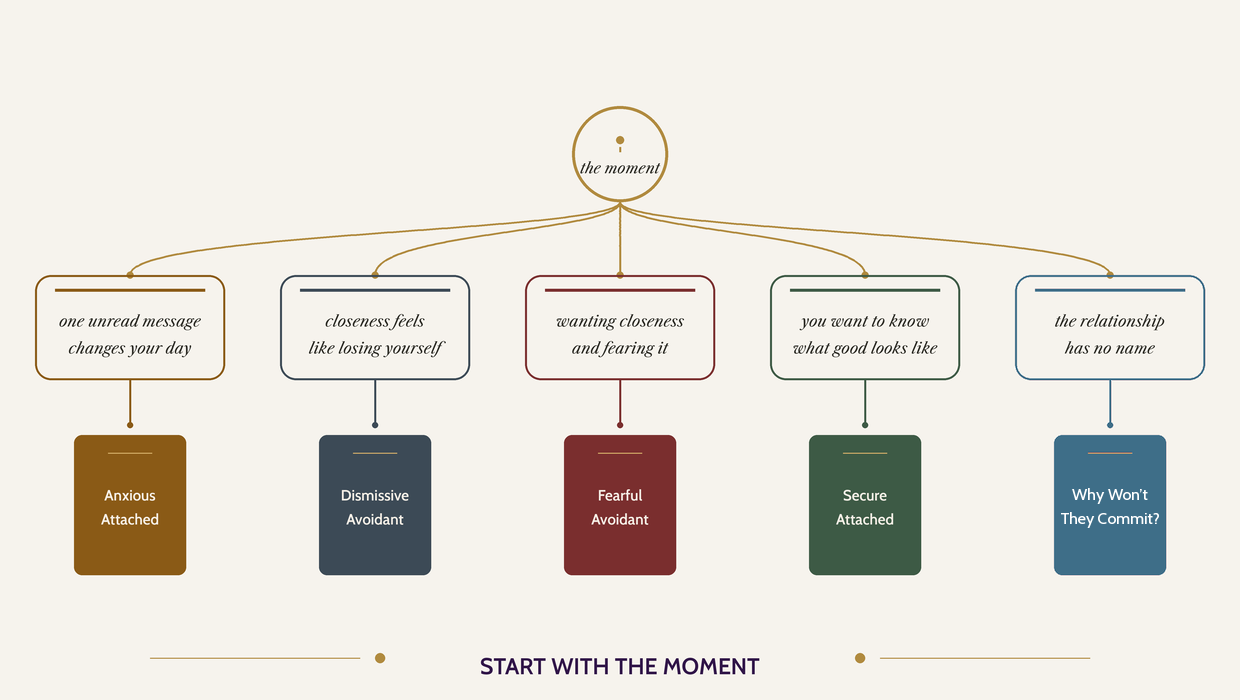
A router starting from the moment and branching to five book spines: one unread message changes your day, closeness feels like losing yourself, wanting closeness and fearing it, wanting to know what good looks like, and the relationship has no name. Start with the moment.

Start here · 4 min read

Which attachment book do I need?

Start with the moment you recognise rather than the label — a short router to the right book.

Read the article →
A row of dashed circles that grow and shrink, labelled their closeness comes and goes, above a row of solid circles all the same size, labelled you stay the same size. Stay full size.

Attachment · 6 min read

Loving an avoidant without losing yourself

How to stay steady beside a partner who pulls away, what you are allowed to need, and how to tell the pattern easing from the pattern working.

Read the article →
A staircase rising through four steps: awareness, the pause, repair, tolerance, with a dashed bump beside it labelled a softening that fades. Change arrives in order.

Attachment · 6 min read

Avoidant to secure: what real change looks like

The behavioural markers of change, in the order they arrive — and how to tell change from a softening that fades.

Read the article →
A dashed line with three sharp spikes labelled the uncertain one, above a flat solid line labelled the steady one. The spike feels like chemistry; the line feels like nothing, at first. The spike is not the signal.

Attachment · 6 min read

Anxious attachment and dating: why ambiguity feels addictive

The uncertain ones feel like chemistry and the steady ones feel like nothing. Here is why, and how to date differently.

Read the article →
A small trigger, a slower reply, on the left; a large feeling, the whole afternoon, on the right; between them the gap worth understanding. The gap is the pattern.

Attachment · 6 min read

Anxious attachment and relationship anxiety: why small changes feel so big

A slower reply or a different tone can turn into a much bigger question — here is why that gap exists, and what to do with it.

Read the article →
A loop running from uncertainty to reaching, to feeling like pressure, to stepping back, and round again, with the anxious side and the avoidant side each feeding it. The loop is the pattern.

Attachment · 6 min read

Anxious attachment with an avoidant partner

Pursuit, distance, and why the same cycle keeps repeating — from both sides.

Read the article →
Two lines over time: warmth stays high and steady, while fear slowly descends. Healing keeps the warmth; what loosens is the fear.

Attachment · 6 min read

Healing anxious attachment without caring less

What change can look like: clearer asks, less checking, more self-trust.

Read the article →
A week from Monday to Sunday drawn as a near-flat line of closeness: a call made when promised, a plan that moves, someone saying no, one argument that dips and is repaired, both people with needs. The ordinary is the pattern.

Attachment · 6 min read

What healthy love looks like on an ordinary Tuesday

The ordinary habits behind trust, closeness, boundaries and repair.

Read the article →
A jagged dashed line labelled what love used to feel like, above a steady solid line labelled what secure love feels like. It reads as nothing at first and as safety over time. Calm is not empty.

Attachment · 5 min read

Why secure love can feel unfamiliar

Why steadiness can feel strangely quiet after unstable relationships.

Read the article →
One calm surface with a magnifying glass over it, opening into two boxes: made of security, with trust that holds, needs said out loud and disagreement surviving; and made of suppression, with feeling held down, staying disengaged and keeping the peace at any cost. What the calm is made of.

Attachment · 5 min read

Secure — or just calm?

What healthy steadiness is made of, and how to tell it from a convincing surface.

Read the article →
Disorganized attachment from the partner's side: closeness rises, reverses into distance, and rises again — the repeating wave is the pattern

Attachment · 4 min read

When your partner has disorganized attachment

They reach for you, then pull back. The reversal has a logic underneath — and knowing it changes what the distance means.

Read the article →
The the quiet fade sequence from the partner's side: closeness steps down towards distance in one direction — a staircase, not a wave

Attachment · 4 min read

When your partner is dismissive avoidant

No storm — a fade. Why distance follows the good moments, and what steadiness can actually reach.

Read the article →
Why a fearful avoidant pulls away: one moment of closeness triggers two opposing systems, approach and withdrawal

Attachment · 4 min read

Why fearful avoidants pull away after closeness

The warm night, then the cold morning — the reversal that makes no sense from the outside has a logic on the inside.

Read the article →
Fearful-avoidant and disorganized attachment: two names from two research traditions for one avoidant pattern

Attachment · 4 min read

Fearful avoidant or disorganized attachment? Why one pattern has two names

Same person, two names — and the places where the label you use genuinely matters.

Read the article →
Can a fearful avoidant change: the path from a defended pattern to earned security, marked by responsibility, repair and consistency

Attachment · 4 min read

Can a fearful avoidant change? What earned security requires

Yes, with conditions — what earned security actually asks for, and how to tell real change from a good intention.

Read the article →
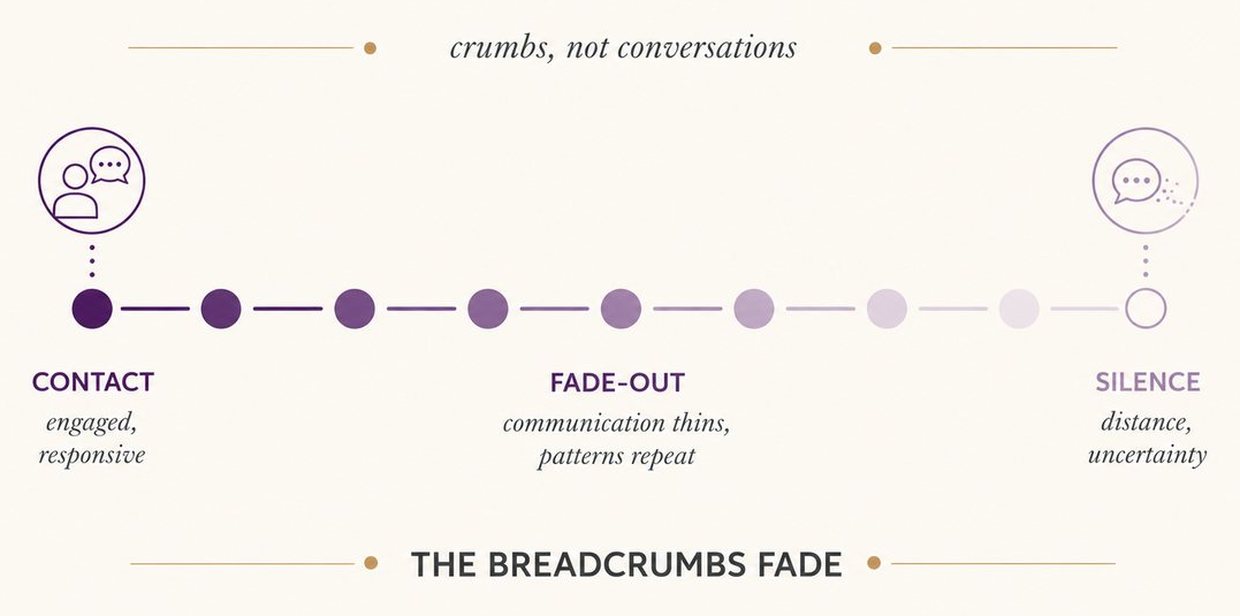
Breadcrumbs fading into silence

Situationships · 6 min read

Breadcrumbing, benching and the slow fade: a decoder

Modern ambiguity has a vocabulary. Here's what each behaviour actually is, what it predicts — and the one question that cuts through all of it.

Read the article →
The grey zone between together and not

Situationships · 5 min read

The grey zone: why "situationship" resists a definition

Between "together" and "not together" is a space with no agreed name — and that ambiguity is doing more work than it looks. Here's what the grey zone is, and how to find where you actually stand.

Read the article →

More is on the way.

New attachment and relationship articles publish alongside each launch. In the meantime, the books go deeper.

Beyond the journal

Every pattern, worked through in full.

The journal is where ideas begin. The books are where they are mapped — clearly, and for both sides.

Explore the books