Situationships · 3 min read
Breadcrumbing, benching and the slow fade: a decoder
Modern ambiguity has a vocabulary. Here's what each behaviour actually is, what it predicts — and the one question that cuts through all of it.
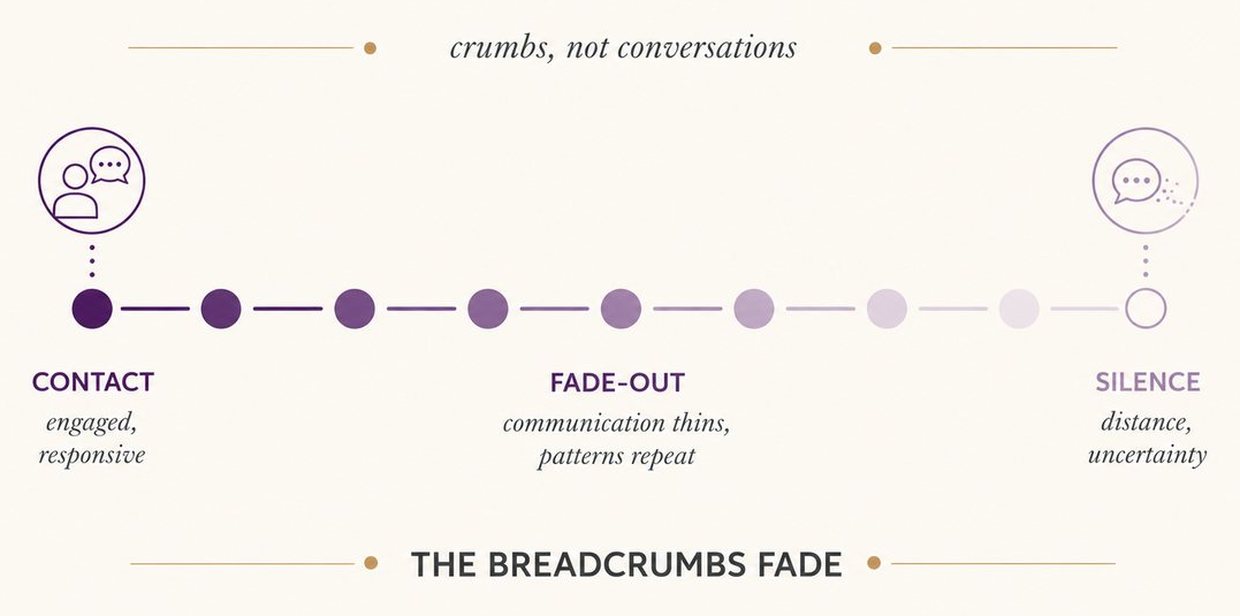
If you've ever stared at a two-word reply after four days of silence and felt your whole week reorganise itself around it, you already know the experience. What you may not have is the vocabulary — and naming the behaviour precisely is the first step to deciding what to do about it.
Breadcrumbing
Small, irregular signals of interest — a like, a late-night message, a 'thinking of you' — dropped at intervals just wide enough to keep you looking for the next one. It costs the sender almost nothing. It costs you your attention, because irregular reward is precisely the schedule that keeps a nervous system checking. The behaviour predicts more of itself: crumbs are the meal.
Benching
You're kept warm while the starting line-up plays elsewhere. Contact rises whenever your attention drifts and falls the moment you're secured. The tell is timing: warmth arrives in response to your distance, not to you.
The slow fade
Not an ending — the absence of one. Replies stretch, plans soften into 'soon', and the relationship is dismantled so gradually there is never a moment to grieve. Grief without an ending is one of the hardest kinds, because your mind keeps a file open that nothing ever closes.
The question that cuts through
Every behaviour in this vocabulary survives on the same fuel: ambiguity that is never named. Which is why the cut-through is a question rather than detective work, spreadsheets of reply times, or one more month of hoping. It is a direct, kind question about what this is — asked once, in plain words, with a willingness to hear the answer.
Clarity is not pressure. You're allowed to know where you stand.
Why these behaviours keep you attached
All three work the same way, and it is worth understanding because it is the reason you stay. Unpredictable warmth is more compelling than steady warmth. A message that arrives after a week of silence lands harder than one that arrives every day, and the relief of it is easy to mistake for love. Psychologists have a name for this pattern of reward; you do not need the name to recognise the feeling of being hooked by exactly the person who gives you least.
Knowing that the pull is manufactured by the intermittency rather than by the person's qualities is oddly freeing. It means the intensity you feel is evidence about the arrangement, and evidence about the arrangement is something you can act on.
What to do once you can name it
The behaviours decode; they do not decide. Once you can see breadcrumbing for what it is, the question that remains is the one that matters: do you want to keep receiving crumbs, and if not, what are you willing to say? The useful next move is rarely a confrontation about their behaviour. It is a plain statement about yours: "I have noticed we only really talk when you reach out, and I would like something more consistent than that. Is that something you want too?"
That sentence does two things. It names the pattern without accusing, and it asks for an answer rather than another signal. Whatever comes back, you will know more than the crumbs were ever going to tell you.
Go deeper
This is the vocabulary. The book is the guide. The five profiles and the exact scripts are all in Why Won’t They Commit?.
Explore the book →Background reading, independent of the books: R. Chris Fraley, University of Illinois, A Brief Overview of Adult Attachment Theory and Research · Bartholomew & Horowitz (1991), Journal of Personality and Social Psychology, the four-category model of adult attachment · Hazan & Shaver (1987), Journal of Personality and Social Psychology, romantic love as an attachment process.