Attachment · 4 min read
Which attachment book do I need?
Start with the moment you recognise rather than the label. A short, honest router to the book that maps your pattern — or your partner's.
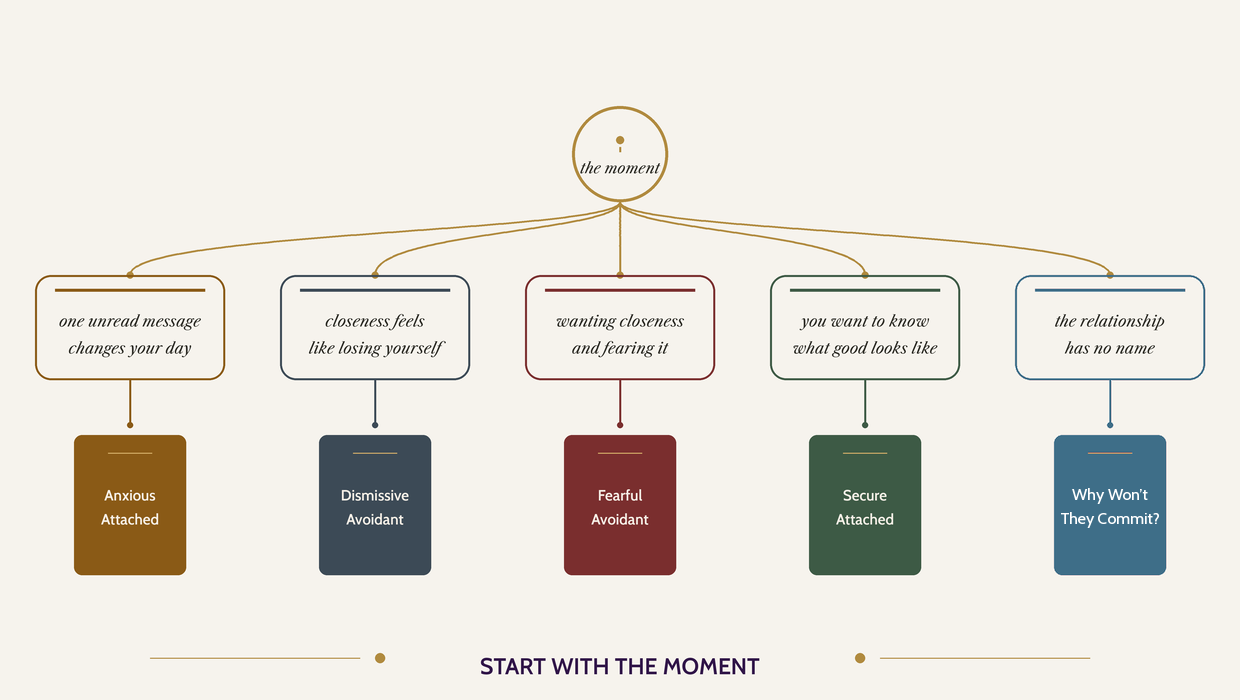
If you have been reading about attachment for a while, you may know the words and still be unsure which book is yours. That is normal: the labels overlap, the internet uses them loosely, and most people carry more than one tendency. So this router skips the labels and starts where the books start — with the moment.
If one unread message can change your whole day
You replay conversations. Reassurance helps and then wears off. A change of tone feels like the beginning of the end, even when part of you knows it probably is not. That is the anxious pattern, and The Anxious Attached maps it from both sides: for the person who feels the alarm first, and the partner who wants to understand why a quiet day can weigh so much.
If closeness starts to feel like losing yourself
You care, and you still feel relief when there is space. Good weekends are followed by quieter weeks. Or you are the partner, wondering why warmth faded as the relationship became more real. That is the dismissive-avoidant pattern, and The Dismissive Avoidant is the guide: how the fortress was built, what it protects, what it costs, and where the door is.
If you want closeness and fear it in the same breath
You reach for someone and then need to escape them. You miss people the moment you push them away. Or you love someone who does exactly that, and the reversals make no sense from where you stand. That is the fearful-avoidant pattern, also called disorganized attachment, and The Fearful Avoidant maps the whole of it, from the Two-Alarm System to the path towards earned security.
If you want to know what good actually looks like
You have read about the insecure patterns and you want the model: what secure love looks like on an ordinary Tuesday, how secure couples handle conflict, how closeness and independence live together. The Secure Attached is that book, and it is written for every pattern, because it is the destination the others point toward.
If the problem is that the relationship has no name
You act like a couple and cannot say the word. Every attempt at "what are we" changes the subject. That is a problem you can name before you can name the pattern, and Why Won’t They Commit? gives you the psychology and the exact words to get clarity, commit, or walk away.
If you are still unsure
The interactive version of this page is the two-minute pattern finder: twelve questions, answered for yourself or for someone you love, with a first and second read at the end. Two more shortcuts. If "avoidant" is the word you keep meeting and you are unsure which kind, the avoidant attachment guide separates the two. And if it is the same relationship problem that keeps happening with different people, why relationship patterns repeat will show you the shape before you choose the book.
Go deeper
All the books share one method: the question you actually asked, the same moment from both sides, the pattern named carefully, practical tools, and research you can inspect. Browse the bookshelf or start with your question.
Background reading, independent of the books: R. Chris Fraley, University of Illinois, A Brief Overview of Adult Attachment Theory and Research · Hazan & Shaver (1987), Journal of Personality and Social Psychology, romantic love as an attachment process.